
Table of Contents
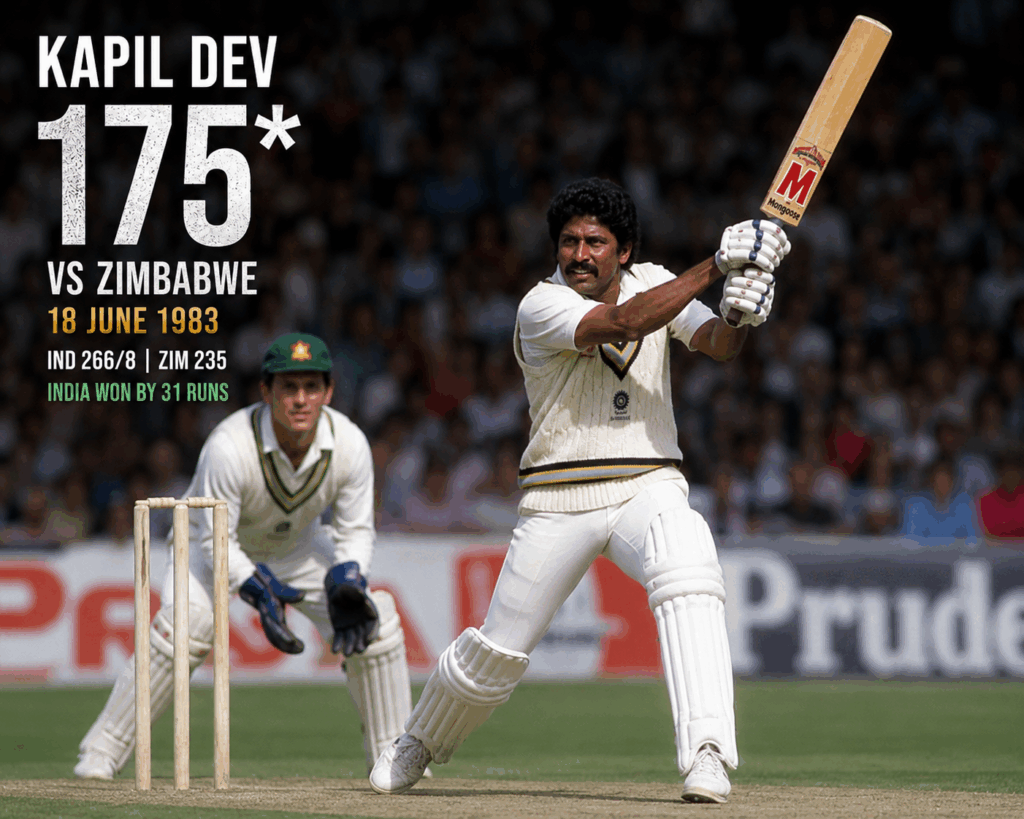
The story of Kapil Dev’s legendary journey began when the Indian cricket team arrived in the United Kingdom for the 1983 Cricket World Cup. Before the tournament started, Kapil Dev made a bold statement expressing his confidence in India’s ability to compete with the best teams in the world. His words inspired millions of fans back home and instilled a sense of belief among his teammates. That confidence not only fueled India’s remarkable World Cup campaign but also sparked hope and ambition for future generations of Indian cricketers.
Introduction to a Historic Day
Cricket has witnessed countless memorable innings over the decades, but only a handful have genuinely changed the course of history. One such innings was played on June 18, 1983, when Indian captain Kapil Dev produced a breathtaking unbeaten 175 against Zimbabwe National Cricket Team during the 1983 Cricket World Cup. It was not a final, a semifinal, or even a knockout match. Yet, many cricket historians consider it one of the most important innings ever played.
What makes this knock extraordinary is not just the score of 175 runs. It is the situation in which it was played. India was reeling at 17 for 5, staring at a humiliating defeat. The team’s top order had collapsed, and the World Cup campaign was hanging by a thread. At that moment, the hopes of millions of Indian cricket fans seemed to be fading away. Then came an innings that transformed despair into belief and turned a struggling team into future world champions.
Even today, more than four decades later, Kapil Dev’s unbeaten 175 remains a symbol of leadership, courage, and resilience. It demonstrated that one determined individual could inspire an entire team and alter the destiny of a nation’s sporting future.
The Importance of June 18, 1983 ~ Story of Kapil Dev into the History Books
India’s Position in the Tournament
The 1983 Cricket World Cup was not expected to be India’s tournament. Before the competition began, very few experts considered India a serious contender. The dominant force in world cricket was the West Indies Cricket Team, who had won the previous two World Cups and appeared almost unbeatable.
India had started the tournament impressively by defeating the mighty West Indies. However, losses against Australia and West Indies later in the competition created uncertainty. By the time India faced Zimbabwe at Tunbridge Wells, every match had become crucial. A defeat would have significantly damaged India’s chances of reaching the semifinals.
The pressure was immense. The players knew that another failure could end their dream. Every run, every wicket, and every partnership mattered. The team required someone willing to take responsibility when everything seemed lost.
Why the Match Was a Must-Win
Zimbabwe was not viewed as an easy opponent. They had already shocked Australia earlier in the tournament and had proven they could challenge established cricketing nations. India could not afford complacency.
The significance of this match becomes clearer when viewed through the lens of history. Had India lost, the semifinal qualification path would have become extremely difficult. Cricket experts often point to this game as the turning point of India’s entire World Cup campaign. Without victory against Zimbabwe, the famous triumph at Lord’s just a week later might never have happened.
In many ways, June 18, 1983, was the day when India’s World Cup hopes were reborn. It was the day when belief replaced fear and possibility replaced uncertainty.
Setting the Stage at Tunbridge Wells
The Venue and Conditions
The match took place at the historic Nevill Ground in Tunbridge Wells, England. Unlike modern cricket stadiums packed with tens of thousands of spectators, this ground provided a more intimate setting. Few people could have imagined that one of cricket’s greatest innings would unfold there.
The conditions favored disciplined bowling. The pitch offered assistance to seamers, making batting challenging. Early movement troubled Indian batsmen, and Zimbabwe’s bowlers exploited those conditions perfectly. What began as a routine World Cup fixture soon evolved into a battle for survival.
The atmosphere became increasingly tense as wickets kept falling. Every dismissal added pressure, not just on the remaining batsmen but on India’s entire tournament campaign.
Zimbabwe’s Growing Reputation
Zimbabwe entered the match with confidence. Their bowling attack featured talented players capable of exploiting favorable conditions. They sensed an opportunity to eliminate a higher-ranked opponent.
The Zimbabwean bowlers struck relentlessly. Their disciplined line and length created chaos among India’s batsmen. Before long, India’s dressing room found itself witnessing one of the worst collapses in World Cup history.
This was not a weak opposition being overpowered. Zimbabwe was playing quality cricket, making Kapil Dev’s achievement even more remarkable.
India’s Nightmare Start
Collapse to 17 for 5
The scorecard looked almost unbelievable. India lost key batsmen in quick succession and crashed to 17 for 5. Legends such as Sunil Gavaskar, Kris Srikkanth, Mohinder Amarnath, and Sandeep Patil were already back in the pavilion.
At that stage, many expected India to be bowled out for less than 100 runs. The situation resembled a ship sinking rapidly in stormy waters. Every wicket increased the sense of panic. The crowd, commentators, and players all recognized the severity of the crisis.
Modern cricket fans often witness dramatic recoveries, but in the context of 1983, such a comeback appeared nearly impossible. The pressure on the incoming captain was enormous.
The Dressing Room Shock
Imagine sitting in the dressing room and watching half your team dismissed before reaching 20 runs. That was the reality for India. Confidence was disappearing with every wicket.
Players later recalled the disbelief surrounding the collapse. The team had entered the match expecting a competitive contest, not a batting disaster. Yet cricket often produces moments when everything goes wrong simultaneously.
The dressing room needed inspiration. It needed a leader willing to fight when defeat seemed inevitable. Fortunately for India, that leader was Kapil Dev.
Kapil Dev Walks In
The Captain’s story of Kapil Dev begins by Taking Responsibility
When Kapil Dev arrived at the crease, India’s World Cup hopes appeared to be slipping away. Most captains would have focused on damage limitation. Kapil chose a different path.
He refused to surrender. Instead of playing defensively and hoping for survival, he began rebuilding the innings with patience and intelligence. He carefully assessed the conditions, respected good deliveries, and punished loose bowling.
Great leaders reveal themselves during crises, not during comfortable victories. Kapil’s approach reflected exactly that principle. Rather than becoming overwhelmed by pressure, he embraced responsibility.
His body language inspired teammates. Every boundary restored confidence. Every partnership strengthened belief. Slowly but surely, the impossible began to look achievable.
Building the Rescue Mission
Kapil understood that scoring quickly alone would not save India. He needed to bat deep into the innings. The challenge required a balance between aggression and patience.
As overs passed, his confidence grew. Boundaries started flowing more regularly. Zimbabwe’s bowlers, who had dominated the opening phase, suddenly found themselves under pressure.
The innings evolved like a masterfully written story. It began with survival, progressed into recovery, and eventually transformed into domination. Kapil’s shot selection, temperament, and leadership combined to create a masterpiece that cricket fans still celebrate today.
The Story of Kapil Dev: Partnerships That Turned Defeat into Victory
Support from Roger Binny
Even the greatest individual innings require support. Roger Binny provided valuable assistance during a critical phase of the recovery. Their partnership helped stabilize the innings and prevented further collapse.
Binny’s contribution may not appear spectacular on the scorecard, but it was essential. Cricket partnerships are often like building a bridge. One player may provide the strength, while the other ensures stability.
Together, they shifted momentum away from Zimbabwe and back toward India.
Contributions from Madan Lal
Another crucial partnership came with Madan Lal. At a time when India still needed significant runs, Madan Lal stayed with his captain and helped extend the innings.
These supporting contributions allowed Kapil to continue attacking. Every over survived increased frustration among Zimbabwe’s bowlers. The recovery was gaining momentum.
The innings demonstrated that team success often depends on collective effort, even when one player dominates headlines.
The Crucial Stand with Syed Kirmani
The most important partnership came between Kapil Dev and Syed Kirmani. Together, they added an unbeaten 126 runs for the ninth wicket.
Kirmani played a vital supporting role, rotating the strike and allowing Kapil to unleash his attacking strokes. By the end of the innings, India had climbed from 17 for 5 to an astonishing 266 for 8.
This partnership transformed the match completely. What seemed like a certain defeat had become a competitive total.
The Story of Kapil Dev’s 175*: Setting New Benchmarks in ODI Cricket
First Indian ODI Century
Kapil Dev’s innings carried historic significance beyond the match situation. His 175* became the first ODI century scored by an Indian batsman.
At a time when one-day cricket was still developing, reaching three figures was a major achievement. Kapil did not merely score a century; he shattered records and expectations.
The innings announced India’s arrival as a serious cricketing nation capable of producing world-class performances under pressure.
A World Record Knock
Kapil’s 175 not out came from just 138 deliveries and included 16 fours and 6 sixes. It was the highest individual ODI score in the world at that time.
| Statistic | Kapil Dev’s Innings |
|---|---|
| Runs | 175* |
| Balls Faced | 138 |
| Fours | 16 |
| Sixes | 6 |
| Team Score | 266/8 |
| Match Result | India won by 31 runs |
The numbers alone are impressive. The context makes them legendary.
How One Innings Changed a Nation: The Story of Kapil Dev’s 175*
Winning the Match
India eventually posted 266 for 8, a total that had seemed impossible earlier in the day. Zimbabwe fought hard in reply but was bowled out for 235. India secured a vital 31-run victory.
Kapil also contributed with the ball, taking a wicket while maintaining excellent economy. His all-round performance underlined why he remains one of cricket’s greatest all-rounders.
The victory kept India alive in the tournament and restored confidence within the squad.
Impact on the 1983 World Cup Triumph
Many cricket experts believe India’s World Cup victory began with this innings. Without Kapil’s rescue act, India may never have reached the semifinals.
The knock instilled belief throughout the team. Players started viewing themselves differently. They no longer saw themselves as underdogs merely hoping to compete. They began believing they could win.
Just eight days later, India defeated the mighty West Indies in the World Cup final and lifted the trophy that changed Indian cricket forever.
The Greatest Innings Never Televised: The Untold Story of Kapil Dev’s 175*
One of the most fascinating aspects of this innings is that no official broadcast footage exists. Due to broadcasting decisions and logistical constraints, the match was not televised.
This absence of footage has added a mythical quality to the innings. Fans rely on scorecards, newspaper reports, eyewitness accounts, and memories to understand what happened.
In an era where every ball is recorded from multiple angles, it seems unbelievable that one of cricket’s greatest innings exists primarily through storytelling.
The mystery only enhances its legend.
Legacy of Kapil Dev’s 175*
More than forty years later, Kapil Dev’s unbeaten 175 remains one of the most celebrated innings in cricket history. It symbolizes resilience, leadership, courage, and self-belief.
The knock represents far more than statistics. It stands as proof that extraordinary achievements often emerge from the most difficult circumstances. When India was at its lowest point, Kapil produced its finest hour.
Every generation of Indian cricketers has drawn inspiration from this innings. Whether it is batting under pressure, leading from the front, or refusing to surrender, the lessons remain timeless.
For many fans, this was not merely an innings. It was the moment Indian cricket discovered its destiny.
Conclusion
The Story of Kapil Dev is one of courage, leadership, and unwavering belief. Kapil Dev’s unbeaten 175 against Zimbabwe on June 18, 1983, remains one of the greatest rescue acts in sporting history. Coming to the crease with India struggling at 17 for 5, he transformed certain defeat into a memorable victory and kept India’s World Cup dream alive. His innings combined courage, intelligence, aggression, and leadership in equal measure. More than just a remarkable knock, it became a defining chapter in the Story of Kapil Dev, inspiring generations of cricketers and cricket fans across India.
His heroic performance not only saved the match but also paved the way for India’s historic 1983 World Cup triumph, forever cementing his legacy as one of the greatest captains in cricket history.
The knock delivered India’s first ODI century, set a world record, and ultimately paved the way for the nation’s historic World Cup triumph. Despite never being televised, it continues to inspire cricket lovers around the world.
Whenever discussions arise about the greatest innings ever played, Kapil Dev’s 175* deserves a place at the very top. It was not just a match-winning performance—it was an innings that changed Indian cricket forever.
FAQs
1. When did Kapil Dev score 175* against Zimbabwe?
Kapil Dev scored his famous unbeaten 175 on June 18, 1983, during the Cricket World Cup at Tunbridge Wells, England.
2. What was India’s score when Kapil Dev came to bat?
India had collapsed to 17 for 5, putting their World Cup campaign in serious danger.
3. How many balls did Kapil Dev face for his 175*?
He scored 175 not out from 138 deliveries, including 16 fours and 6 sixes.
4. Why is this innings considered so important?
The innings rescued India from a near-certain defeat, helped secure a crucial victory, and played a major role in India eventually winning the 1983 World Cup.
5. Is there video footage of Kapil Dev’s 175*?
No. The match was not televised, making it one of the greatest cricket innings ever played without official broadcast footage.
published by Manoj.K
Email: manojdigital3672@gmail.com